
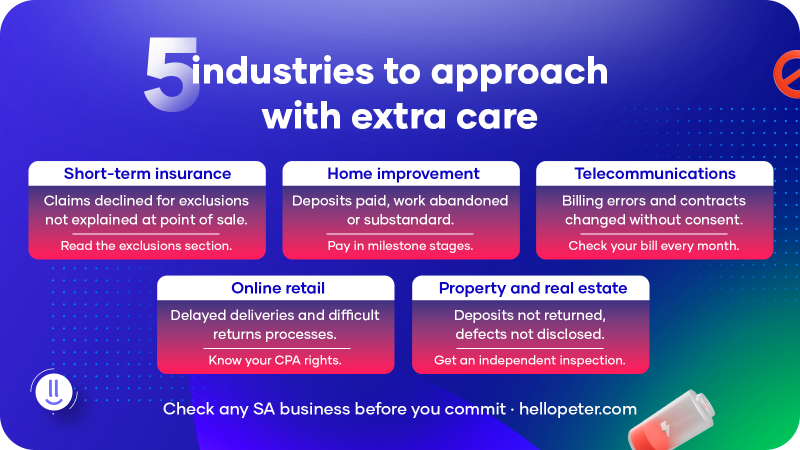
Knowing which industries generate the most consumer complaints in South Africa, and why, is the most practical preparation you can do before a significant purchase. Here are the five sectors to approach with the most care, and exactly what to watch for in each one.
Consumer complaints are not evenly distributed across industries. Certain sectors consistently get higher complaint volumes.
This is not necessarily because every business in those sectors is untrustworthy, but because of the structural characteristics of those industries: high customer volumes, complex or long-term contracts, transactions that involve significant upfront payments, or services where the gap between what’s promised and what’s delivered is difficult to evaluate until after you’ve committed.
Understanding which industries these are, and what the most common complaint patterns look like within each, is one of the most practical things you can do to protect yourself as a South African consumer. It doesn’t mean avoiding these industries, as most of them are unavoidable, but it means approaching them with a specific set of questions and checks that reduce your risk.
The following five industries are among the most consistently high-complaint categories on consumer platforms in South Africa, including Hellopeter. For each one, we’ve described the most common failure patterns and the specific checks you should do before committing.
1. Short-Term Insurance 🚗
Short-term insurance, such as vehicle insurance, home contents, and building insurance, is one of the highest-complaint categories in the South African consumer market, and has been for years.
The reason is structural: the transaction involves paying premiums over months or years for a service you only need once, under circumstances that are usually already stressful (an accident, a theft, a flood). The moment of truth, which is when a claim is submitted, is often the first time a consumer discovers the gap between what they thought they were covered for and what the policy actually pays out.
What Most Often Goes Wrong
- Claims are declined for exclusions that were not clearly explained at the time of sale.
- The processing is delayed significantly beyond the stated timeframe, without communication.
- The assessed value of a claim is substantially lower than the consumer expected, with no clear explanation.
- Policy terms are changed without adequate notice, often at renewal.
How to Protect Yourself
- Before signing, read the specific exclusions section of the policy document, and not just the summary. Ask your broker explicitly: “In what circumstances would this specific claim be declined?”
- Check the insurer’s Hellopeter profile specifically for claims experience. Did you know, you can search for the word “claim” in their reviews? The pattern of claims outcomes is more informative than their overall rating.
- At the claim stage: Submit everything in writing. Keep records of every interaction, every reference number, and every commitment made by the claims team.
2. Home Improvement and Building Contractors 🔨
Home improvement, like renovation contractors, builders, plumbers, electricians, and related tradespeople, generally gets very high complaint volumes across all South African consumer platforms.
The combination of large upfront deposits, work that takes place in your home over an extended period, and quality that’s often only fully apparent after the project is complete creates significant exposure for consumers.
What Most Often Goes Wrong
- Contractors disappear after receiving a deposit or deliver significantly substandard work.
- Project timelines are dramatically exceeded, often with no communication or explanation.
- The final bill is substantially higher than the original quote, with disputed additional charges.
- Post-project defects and warranty claims are ignored or disputed.
How to Protect Yourself
- Get three quotes in writing. A contractor who is significantly cheaper than two comparable quotes warrants careful scrutiny of what they’re not including.
- Pay deposits in stages linked to project milestones, and not one large upfront payment. Any reputable contractor will agree to this arrangement.
- Check the contractor’s Hellopeter and Google profiles specifically. For a significant renovation, also ask for two or three references you can contact directly.
- Get a written contract that specifies the scope of work, the timeline, the payment schedule, and what happens if there are defects after completion.
3. Telecommunications (Mobile Networks and ISPs)📱
Nearly every South African has a direct personal relationship with at least one telecoms provider, which means the sheer volume of potential complaints is enormous.
What Most Often Goes Wrong
- Billing errors, including charges for services not subscribed to or after cancellation.
- Service outages and connectivity failures are not acknowledged or resolved promptly.
- Contract upgrades or changes were applied without clear consumer consent.
- Customer service that is difficult to reach or that fails to resolve issues after multiple contacts.
How to Protect Yourself
- Check your bill every month. Billing errors in telecoms are not rare, and they are often only discovered months after they begin.
- Keep written records of any changes to your contract, such as upgrades, cancellations, and new services added. An email confirmation from the provider is the minimum you should accept.
Before signing a new contract, check the telecommunications provider’s Hellopeter profile, specifically for complaints about billing and customer service responsiveness, which are the two most consistent failure patterns.
4. Online Retail and E-Commerce 🛍️
South Africa’s e-commerce sector has grown rapidly, and consumer complaints have grown with it. The specific failure patterns in online retail are distinct from physical retail, as they tend to cluster around delivery, product accuracy, and returns.
What Most Often Goes Wrong
- Deliveries that are delayed, lost, or arrive damaged without proactive communication.
- Products that don’t match their description, photos, or stated specifications.
- Returns and refund processes that are difficult to navigate, slow, or ultimately unsuccessful.
- Customer service that is responsive before the sale and difficult to reach after it.
How to Protect Yourself
- For any purchase above R500, check the retailer’s review profile before buying, specifically looking at reviews that mention delivery and returns, which are the two highest-complaint areas.
- Screenshot the product description and stated delivery timeframe at the time of purchase. If the product arrives in a different condition or later than stated, this documentation supports your consumer rights claim.
- Know your rights: for online purchases, you have a right to cancel within seven calendar days of delivery without giving a reason under the Electronic Communications and Transactions Act. This is separate from the CPA’s cooling-off period, which applies specifically to direct marketing situations.
5. Property and Real Estate Services 🏡
Estate agents, property developers, rental agents, and related property services generate significant consumer complaint volumes, particularly around deposits, lease management, and disclosure obligations.
What Most Often Goes Wrong
- Rental deposits are not returned within the legally required timeframe (within seven days if no damage, or fourteen days after a damage assessment if applicable).
- Property defects are not disclosed at the time of sale or rental, leading to disputes after occupation.
- Estate agents misrepresent properties or fail to disclose material information.
- Levy and rates information for sectional title properties is inaccurate or incomplete.
How to Protect Yourself
- Know your legal rights on deposits: the Rental Housing Act is specific about timelines and conditions. An agent who cannot clearly state the conditions under which deductions will be made from your deposit is a red flag.
- For any property purchase, have an independent inspection done by a qualified building inspector before signing an Offer to Purchase. Sellers are obligated to disclose known defects, but disclosure obligations have limits.
- Check the estate agency’s Hellopeter profile specifically for reviews mentioning deposits and post-occupancy issues. These are the most common failure points, and patterns in reviews are the most reliable predictor of your experience.
The One Thing All Five Industries Have in Common
Looking across these five industries, there’s a consistent theme in the complaints that generate the most frustration for South African consumers: a gap between what was promised or presented at the point of sale, and what was delivered after the transaction was committed.
The best protection against this gap is the same in every industry: check the track record before you commit. Read reviews specifically for the failure patterns described above, and not just the overall rating. And know your rights under the Consumer Protection Act, which applies to all five of these industries and gives you meaningful recourse when things go wrong.
For the complete framework for evaluating any South African business before you spend, see:
And for guidance on what specifically to look for in a business’s review profile, see:
|
Disclaimer
The industries, complaint patterns, and consumer guidance described in this article are based on general observations of recurring themes in South African consumer behaviour and publicly available information. They are intended to help you ask better questions before committing to a purchase or contract — not as a comprehensive legal guide or as definitive conclusions about any individual business or sector. Legal rights referenced (including those under the Consumer Protection Act and the Rental Housing Act) are summarised for general awareness; always consult a qualified legal professional for advice specific to your situation. Review profiles and platform data are updated continuously, so always visit hellopeter.com for the most current information before making a purchasing decision.