This analysis is based on Hellopeter‘s TrustIndex data. It’s drawn from a community of over 1.4 million verified South African reviewers. No business has paid to appear in these findings. The data reflects what real customers say, not what marketing departments want you to believe.
Something has shifted in the relationship between South African consumers and the businesses they spend money with. The shift has been building for years, accelerated by a period of economic pressure that has made every rand feel more consequential, and sharpened by the growing availability of consumer review data that makes it easier than ever to separate businesses that deliver from those that merely promise.
As South African consumers in 2026, we’re more informed, more cautious, and more vocal than at any point in the country’s retail and service history. We check reviews before we buy. We share our experiences online. And we’re increasingly making decisions not based on advertising, but on the collective voice of other South Africans who have been there first.
The Impact of a Business’s Reputation
This creates a new kind of accountability for businesses. And it’s one that cannot be managed by a marketing campaign alone. A business’s reputation in 2026 is built one customer interaction at a time, and is measured continuously by the consumers who experience it.
Therefore, the most trusted businesses in South Africa today are not the ones with the biggest advertising budgets. They’re the ones that consistently deliver what they promise, handle failures well when they happen, and treat customer feedback as a signal worth acting on.
This report draws on Hellopeter’s TrustIndex data, the most comprehensive measure of consumer trust in the South African business landscape, to identify what trust looks like across industries, what the most trusted businesses have in common, and what the data reveals about where SA consumers are most and least satisfied in 2026.
How We Measured Trust: The TrustIndex Explained
The TrustIndex is Hellopeter’s proprietary business rating system, and it’s the metric we use throughout this report. Unlike a simple average star rating, the TrustIndex accounts for review volume, recency, response behaviour, and rating distribution, giving a more accurate, more nuanced picture of a business’s actual trustworthiness than stars alone.
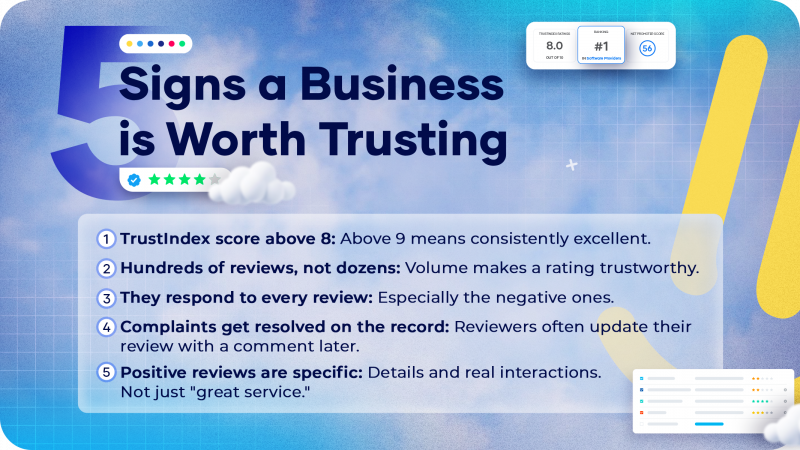
A TrustIndex score above 8 out of 10 is considered strong. A score above 9 reflects consistent, high-volume excellence. A score below 6 is a signal that consumers should look carefully at the review record before committing. Throughout this report, we use the TrustIndex as our primary measure of consumer trust, alongside review volume, response rate, and the qualitative themes that emerge from the review content itself.
The data in this report is based on the live Hellopeter review database. All businesses and industries referenced are based on verified consumer reviews from real South African customers. This is not sponsored content, does not contain paid placements, or curated selections. If a business appears in a positive context, it’s because the data says so. If a sector appears with caveats, those caveats are what the consumer review record shows.
What the Most Trusted SA Businesses Have in Common
Before looking at industry-by-industry findings, it’s worth identifying the characteristics that consistently appear in the review profiles of South Africa’s most trusted businesses. These are not abstract qualities. They’re specific, observable behaviours that repeatedly appear in the review data.
-
They Respond to Reviews (All of Them)
The single most consistent characteristic of high-TrustIndex businesses on Hellopeter is response rate. Businesses that score above 8.5 consistently engage with their reviews, and not just the positive ones. They respond to critical reviews specifically, address the actual content of the complaint, and show a genuine effort to resolve the issue.
This behaviour signals to every future customer who reads that review that the business takes feedback seriously and that, if something goes wrong with their own transaction, they’re unlikely to be ignored.
-
Their Review Volume is Substantial
Trust that is built on a small number of reviews is fragile. South Africa’s most consistently trusted businesses tend to have substantial review volumes, with hundreds or thousands of reviews accumulated over time.
This volume makes the rating statistically robust and gives consumers a genuine sample to draw conclusions from. A business that has earned 800 reviews over three years and maintained a TrustIndex above 8 throughout that period has demonstrated something that a business with 20 reviews and a perfect score simply cannot.
-
Their Negative Reviews Show Resolution
No business avoids all negative reviews. What separates the most trusted businesses from the rest is not the absence of critical feedback, but what happens after it.
In the reviews of South Africa’s highest-rated businesses, a clear pattern emerges: negative reviews are frequently followed by business responses that lead to resolution, and reviewers often update their accounts to reflect that the situation was handled well. This resolution cycle is one of the most powerful trust signals available.
-
Their Positive Reviews Are Specific
Generic positive reviews, such as “great service, highly recommend”, appear in every business’s profile. What distinguishes genuinely trusted businesses is the specificity of their positive reviews.
Reviewers name staff members (only first names to prevent breaching Hellopeter’s content guidelines). They describe specific interactions. They explain exactly what the business did that exceeded their expectations. This specificity signals that the praise is genuine and tells future customers something concrete about what to expect.
Industry-by-Industry Trust Rankings: The 2026 Picture
The following industry analysis draws on Hellopeter’s TrustIndex data as of 2026. Industries are assessed based on average TrustIndex scores, review volume, response rates, and the qualitative themes most frequently appearing in consumer feedback. All findings represent consumer sentiment as expressed through verified reviews, and not editorial opinion.
Short-Term Insurance
Short-term insurance remains one of the most reviewed and most debated categories on Hellopeter. It generates significant review volume, reflecting both the large number of South Africans with insurance products and the high emotional stakes of the claim experience, which is the moment when trust is most severely tested.
The data reveals a significant performance spread within the industry. Some insurers, particularly challengers and newer market entrants who’ve built their model around customer experience, have TrustIndex scores that compare favourably with any sector on the platform. Others, particularly some established players, carry persistent negative review patterns around claim delays and cover disputes.
The most consistently praised insurers in the consumer review data share a common characteristic: their claims handling is proactive. Rather than making customers chase outcomes, they communicate updates without being asked, set clear expectations about timelines, and escalate proactively when those timelines are not met. Consumers who experience this level of service become highly vocal advocates in the review record, and their reviews are specific, credible, and influential.
|
Banking and Financial Services
Banking generates very high review volume on Hellopeter, which is expected, given that virtually every South African adult has a banking relationship. The data shows a nuanced picture: overall banking satisfaction scores have improved modestly over recent years, driven primarily by improvements in digital banking and app-based service, but in-branch experience and complaint resolution remain persistent pain points in the review record.
The banks that score most strongly in the consumer review data tend to be those that have invested in consistent digital experience quality, reducing the need for branch visits and telephonic service for routine matters, while also demonstrating genuine responsiveness when consumers do need to escalate a problem.
The review record is notably positive for banks whose customer service teams engage specifically and substantively with Hellopeter complaints, as opposed to routing reviewers back through standard contact channels.
One finding that clearly emerges from the data: the gap between large banks and smaller financial services providers in consumer trust metrics is narrower than advertising spend would suggest. Several smaller and specialist financial service providers consistently outperform the major banks on response rate, resolution speed, and reviewer satisfaction scores.
Telecommunications
Telecoms is consistently one of the highest-volume and most competitive review categories on Hellopeter. South African consumers have strong, often long-standing relationships with their mobile networks and internet service providers, and they have strong opinions about them.
The data shows that consumer satisfaction in telecoms is disproportionately driven by two factors: reliability of service and responsiveness when things go wrong. A consumer who experiences consistent connectivity and billing accuracy is unlikely to write a review at all. A consumer whose service drops repeatedly, or whose bill is incorrect, is highly motivated to share that experience publicly.
This creates a dynamic in which the review profiles of telecoms companies primarily reflect their failure management rather than their typical service delivery, which is worth understanding when interpreting their ratings.
Telecoms companies with high TrustIndex scores have typically made specific and sustained investments in the responsiveness of their Hellopeter presence, treating it as a genuine escalation channel rather than a reputation management exercise.
Retail and E-Commerce
South African retail, both physical and online, generates significant review volume with a clear structural split: in-store retail reviews tend to focus on staff helpfulness, product availability, and returns handling; online retail reviews cluster heavily around delivery, product accuracy, and the speed of resolution when something goes wrong.
The e-commerce sector shows the widest performance spread of any retail category. Some online retailers have built customer experience into their core operational model and consistently earn TrustIndex scores that reflect this. Others show patterns of strong pre-purchase experience followed by significant drops in satisfaction post-purchase, a profile that signals investment in sales experience without an equivalent investment in after-sales service.
The most consistently trusted online retailers in the SA consumer review data are those whose return and refund processes work as described. Consumer trust is rarely lost on the first purchase. It’s lost on the return, the refund request, or the dispute. The businesses that handle these moments well earn some of the strongest loyalty language in the entire review database.
Property and Estate Agency
Property services generate a relatively lower review volume than their economic significance suggests, as transactions are less frequent, and many consumers engage with estate agents only a handful of times in their lives. But the reviews that do appear in the data are often among the most detailed and most emotionally charged on the platform, reflecting the high stakes of property transactions.
The most consistent theme in negative property reviews is information asymmetry, where consumers felt they were not given accurate or complete information before signing, whether about property condition, transfer costs, levy arrears, or zoning status. Conversely, the most trusted estate agencies in the review data are consistently those whose reviewers describe being kept fully informed throughout a complex process, even when that information was not always positive.
The Industries Where Trust Is Growing (And Where It’s Under Pressure)
Looking at the directional trend in TrustIndex data, comparing recent review sentiment against the historical baseline, some clear patterns emerge.
Trust is growing most strongly in specialist financial services (particularly newer insurers and investment platforms that have built customer experience into their model from the start), specialist retail (businesses with narrow product ranges and deep category expertise), and healthcare services, where digital appointment and follow-up systems have reduced friction.
Trust is under the most pressure in general telecommunications (where service expectations continue to rise faster than delivery quality improves), traditional banking (where the in-branch and telephonic service experience increasingly lags behind the digital one), and building and construction (where the combination of large upfront payments and variable trade quality continues to generate high complaint rates).
What This Data Means for You as a SA Consumer
The trust data in this report is not just interesting reading. It is also actionable intelligence for every South African consumer making purchasing decisions.
When you know that insurance claims handling is the primary driver of trust scores in that industry, you know to read reviews specifically about claims before choosing a provider, not reviews about signing up. When you know that online retail trust is most severely tested at the returns stage, you know to check return policy reviews specifically before making a significant purchase.
And when you know that the most trusted businesses in any category are those that respond to feedback proactively and resolve complaints on the record, you have a powerful filter: before you commit to any significant business, check whether they engage with negative reviews on Hellopeter. That single signal tells you more about how you’ll be treated if something goes wrong than any amount of advertising copy.
How to Use Hellopeter to Find the Most Trusted Business in Any Category
- Go to hellopeter.com and search for the category or business name you’re researching.
- Look at the TrustIndex score alongside the total review count. Both matter.
- Filter or scroll to read recent negative reviews. Look for patterns and for how the business responds.
- Check the response rate. Businesses that engage with all feedback are demonstrating accountability.
- Compare two or three businesses in the same category using the same criteria before making your decision.
Frequently Asked Questions
Can Businesses Pay to Improve Their TrustIndex Ranking?
No. The TrustIndex is calculated entirely from verified consumer reviews and engagement metrics. It cannot be purchased, sponsored, or manipulated through advertising spend on the platform. Businesses that appear positively in TrustIndex rankings have earned those positions through actual customer experience performance.
How Current Is the Data in This Report?
The TrustIndex is updated in real time as new reviews are submitted and approved. The rankings and trends referenced in this report reflect the live review database as of April 2026. The TrustIndex is calculated on a rolling 12-month basis, and scores reflect consistent performance over the past year rather than an all-time historical average.
What If My Experience With a Highly Ranked Business Was Poor?
Individual experiences can and do differ from aggregate data. A business with a high TrustIndex has demonstrated consistently good performance across a large number of interactions, but no business is perfect in every case. If your experience was poor, sharing it through a review is both your right and a contribution to the accuracy of the data that helps other consumers.
Which Industries Have Improved The Most in 2026?
The TrustIndex trend data shows the most meaningful improvement in specialist financial services and specialist retail, which are categories where businesses have made targeted investments in customer experience. The widest performance gaps, between the best and worst performers in the same category, remain in insurance, telecoms, and construction services.
Disclaimer:
The industry rankings, trust scores, and consumer guidance described in this report are based on Hellopeter TrustIndex data drawn from verified South African consumer reviews. They are intended to help you make more informed decisions before committing to a purchase or contract, not as definitive conclusions about the performance of any individual business or sector. TrustIndex scores and review profiles are updated continuously, so always visit hellopeter.com for the most current information before making a purchasing decision.
|
- Read: 5 Industries Where SA Consumers Get Burned Most, and How to Protect Yourself
- Read: The Red Flags Every South African Consumer Should Know